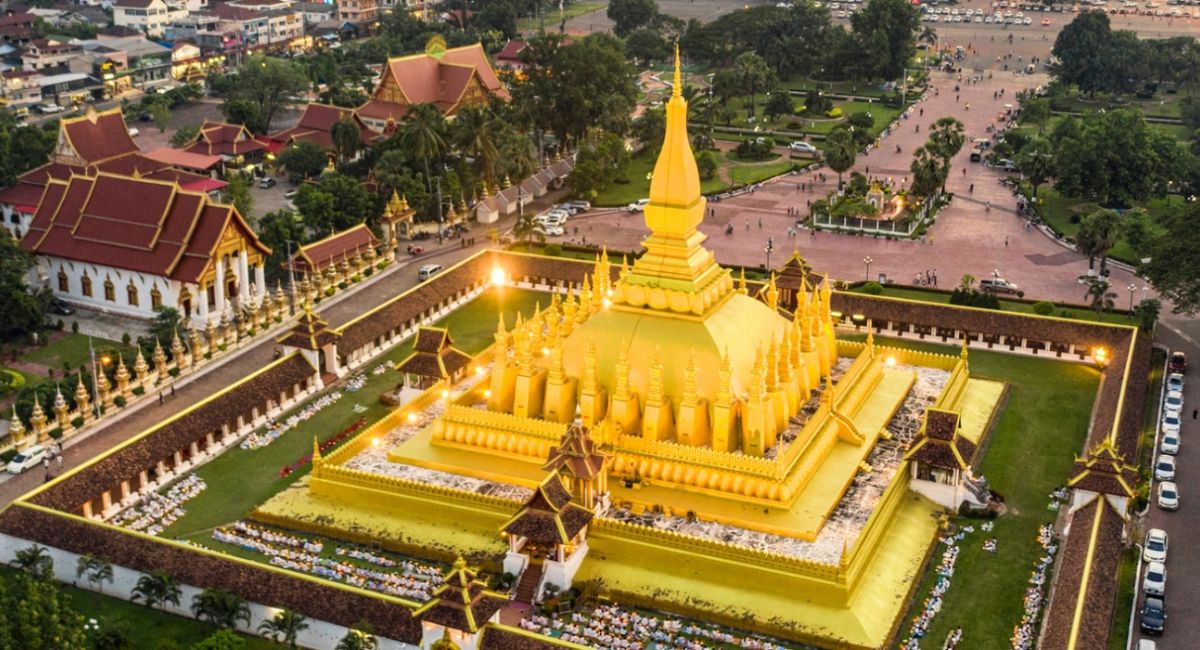
Pha That Luang Travel Guide: Laos’ Golden Symbol of Buddhism. Located in the heart of Vientiane, Pha That Luang is the most important religious monument and the national symbol of Laos. More than just a temple or stupa, it represents the spiritual heart of the Lao people, reflecting Buddhism, history, and national identity.
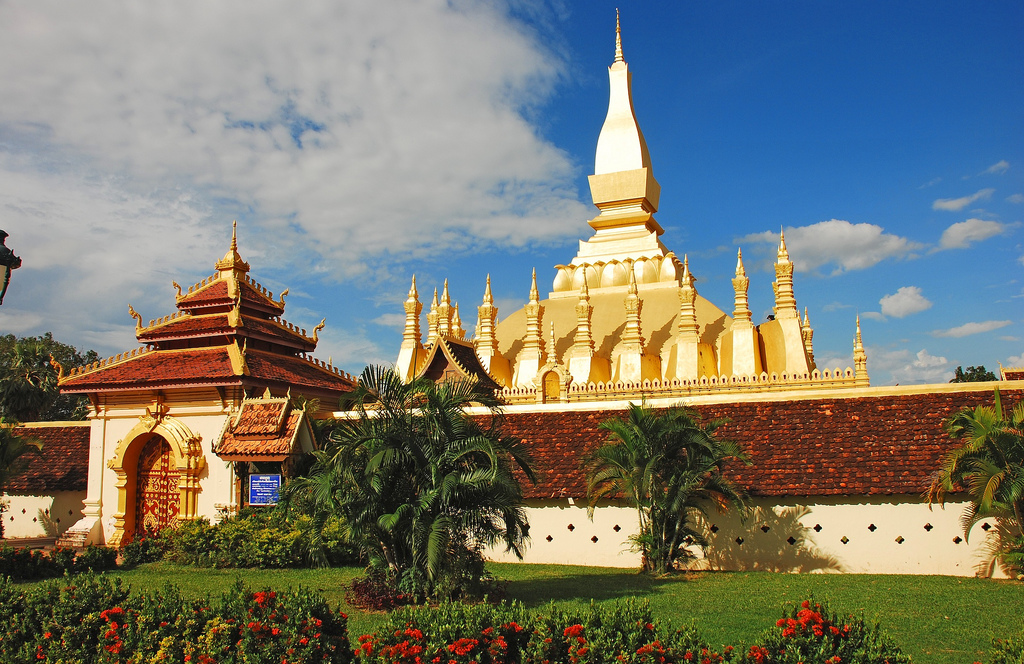
With its shining golden surface reflecting sunlight, Pha That Luang creates a sacred and peaceful atmosphere. For locals, it is the most revered site in the country. For travelers, it is one of the most significant landmarks in Southeast Asia.
Overview of Pha That Luang
Pha That Luang is located in central Vientiane, only about 15–20 minutes from Wattay International Airport.
The complex includes:
- The main golden stupa
- A spacious temple courtyard
- Surrounding walls and smaller religious structures
More than a religious site, it is a national symbol and appears on the national emblem of Laos, showing its deep cultural and spiritual importance.
Deep History of Pha That Luang
1. Origins and Buddhist Legend
Pha That Luang is regarded as the most sacred religious monument in Laos, deeply connected with Theravada Buddhism and national identity. According to Buddhist legend, its origins date back to the 3rd century CE, when Indian monks brought relics of the Buddha to the region.
It is believed that a small stupa was first built to enshrine these sacred relics, marking the site as holy from an early period. Over time, this modest structure gradually developed into an important spiritual center. Local tradition also holds that the site was blessed by the Buddha himself, strengthening its religious significance.
2. Early Religious Role
As Buddhism spread throughout mainland Southeast Asia, Pha That Luang became an increasingly important spiritual site. It was not only a place of worship but also a symbol of faith and spiritual protection for early communities in the region.
Early Lao kingdoms regarded the site as a sacred center where prayers were offered for peace, prosperity, and stability. Although it was not yet the grand monument seen today, it already held deep religious importance in the spiritual life of the local population.
3. Reconstruction under King Setthathirath
A major turning point in the history of Pha That Luang occurred in the 16th century under King Setthathirath, one of the most important rulers of the Lan Xang Kingdom.
When the capital was moved to Vientiane, the king ordered the reconstruction and elevation of Pha That Luang as the most important religious center of the kingdom. From this period onward, it became a symbol of national unity, Buddhist devotion, and royal authority.
It also represented the emergence of a stronger Lao identity, closely tied to religion and statehood.
4. Wars and Periods of Destruction
From the 18th to 19th centuries, the region experienced repeated conflicts, particularly invasions from Siam (modern-day Thailand). During these wars, Pha That Luang suffered severe damage and fell into decline.
As instability continued, the monument was largely abandoned and left in a deteriorated state. Despite its physical destruction, it remained an important spiritual symbol for the Lao people, preserving its sacred meaning in collective memory.
5. Colonial Period and Decline of Preservation
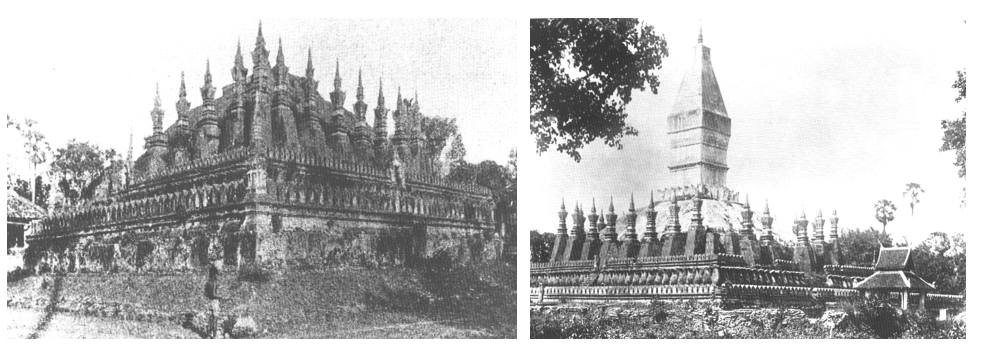
During the French colonial period in Indochina, Pha That Luang was documented and studied by Western researchers. However, preservation efforts were limited, and the structure continued to deteriorate over time.
Although restoration was not a priority during this period, colonial records and surveys later became valuable sources for understanding the original structure and guiding future reconstruction efforts.
6. Restoration and National Revival
In the 20th century, the Lao government and Buddhist monastic community launched major restoration projects to rebuild Pha That Luang. The monument was gradually restored and re-established as a central place of worship.
This restoration carried deep symbolic meaning. It represented not only the physical rebuilding of a monument but also the cultural revival of Laos after centuries of war, colonization, and instability.
7. Modern Significance and Cultural Identity
Today, Pha That Luang stands as the national symbol of Laos and the most important religious site in the country. It plays a central role in major Buddhist ceremonies, especially the annual That Luang Festival, which attracts thousands of devotees and visitors.
Beyond its religious function, it represents resilience, unity, and national identity. The monument reflects the long historical journey of Laos through ancient kingdoms, warfare, colonial rule, and cultural revival, while remaining deeply rooted in Theravada Buddhism.
Architecture & Symbolism of Pha That Luang
1. Sacred Architecture as a Reflection of Lao Identity
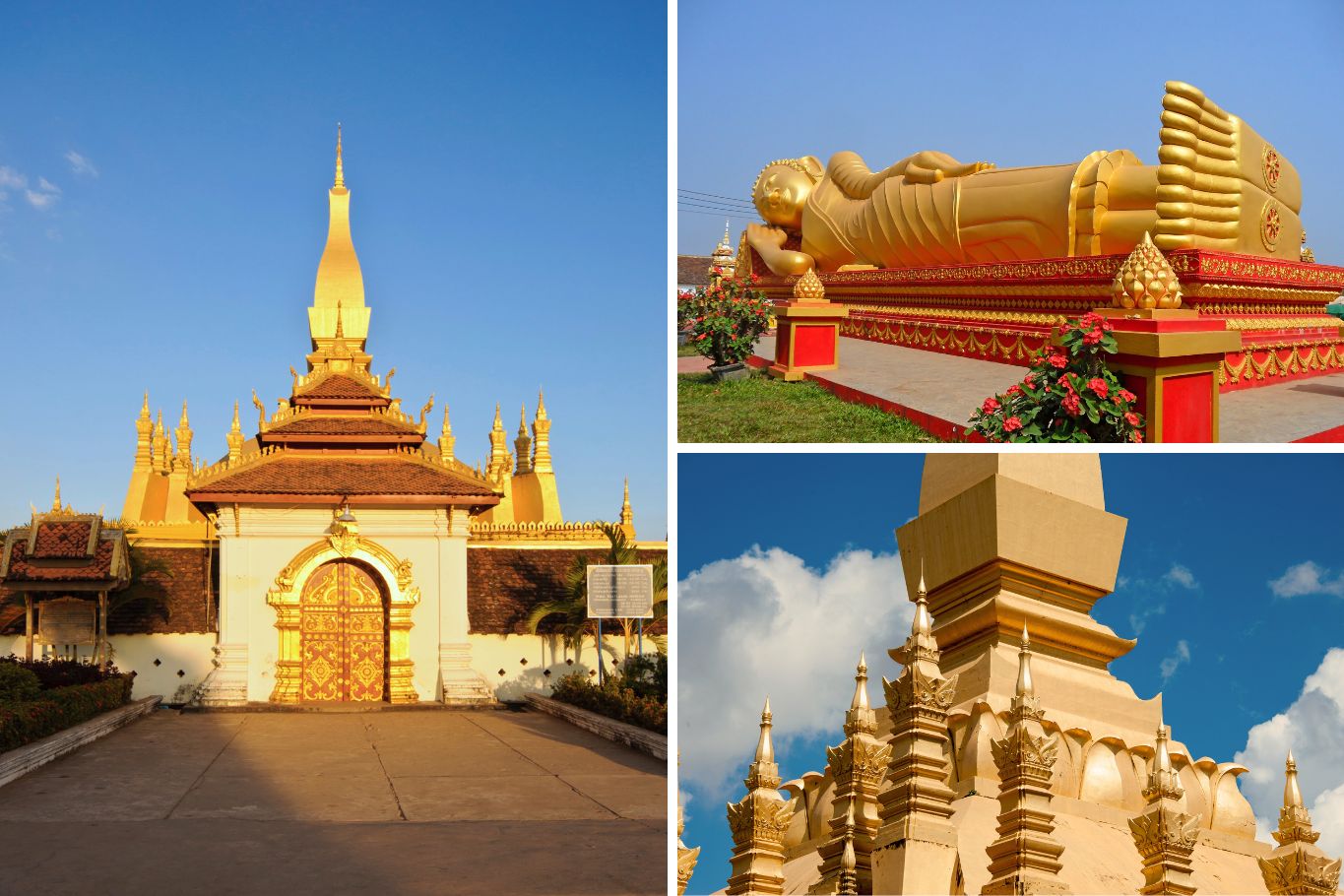
The architecture of Pha That Luang is not only a religious structure but also a powerful expression of Lao cultural identity. It reflects a deep integration of Theravada Buddhism, ancient cosmological beliefs, and traditional Lao artistic expression.
Unlike purely decorative monuments, every element of the stupa carries symbolic meaning. The entire complex is designed to guide the mind from the physical world toward spiritual awakening, representing the Buddhist path from ignorance to enlightenment.
2. The Golden Stupa and Symbol of Enlightenment
At the heart of the complex stands the central golden stupa, which is the most visually striking and spiritually significant element of the monument. The gold covering is not merely ornamental—it symbolizes the highest spiritual ideals in Buddhism.
The golden stupa represents:
- Enlightenment, the ultimate goal in Buddhist practice
- Buddhist wisdom, achieved through understanding and meditation
- Spiritual purity, free from worldly attachment and desire
The radiant golden surface also reflects sunlight, creating a visual impression of divine light, reinforcing the idea that enlightenment is a source of illumination for both mind and spirit.
3. Multi-Layer Structure and Spiritual Journey
The structure of Pha That Luang is built in multiple layers, each representing a different stage of spiritual development. This layered design reflects the Buddhist concept of gradual progression toward enlightenment.
- Lower level: represents the physical world, filled with desire, suffering, and impermanence
- Middle level: symbolizes purification, where individuals begin to detach from material attachments and cultivate moral discipline
- Upper level: represents enlightenment, the state of complete wisdom and liberation
This vertical progression encourages a symbolic journey upward, mirroring the spiritual path in Buddhism where practitioners move from ignorance toward awakening.
4. Lotus Symbolism in Design
The lotus flower is one of the most important symbols throughout the design of Pha That Luang. In Buddhist philosophy, the lotus is a powerful metaphor for spiritual transformation.
The lotus symbolizes:
- Purity, as it grows clean and beautiful despite emerging from muddy water
- Spiritual growth, representing development through life’s challenges
- Enlightenment rising from suffering, showing that wisdom can emerge from difficult conditions
In the context of the stupa, lotus imagery reinforces the idea that human beings can achieve enlightenment regardless of their circumstances, as long as they follow the path of Buddhist teachings.
5. Cosmological Meaning and Sacred Order
The architecture of Pha That Luang also reflects Buddhist cosmology, where the universe is structured according to spiritual hierarchy. The stupa is often interpreted as a symbolic representation of Mount Meru, the center of the universe in ancient Asian cosmology.
This symbolic structure connects the earthly realm with higher spiritual dimensions, emphasizing the idea that the temple is a bridge between humans and the divine. Every layer, shape, and proportion is carefully designed to reflect harmony, balance, and cosmic order.
6. Cultural Influences and Artistic Fusion
The architectural style of Pha That Luang reflects a rich blend of cultural influences, shaped by centuries of regional interaction and religious exchange. It incorporates elements from Lao tradition as well as influences from Khmer Empire and ancient Indian art and religious architecture.
From Indian influence, it inherits Buddhist and Hindu cosmological concepts and symbolic structures. From Khmer tradition, it adopts monumental scale and sacred geometry. Lao artisans then transformed these influences into a uniquely local style characterized by simplicity, elegance, and spiritual depth.
This fusion created a distinct Southeast Asian religious architecture that is both locally rooted and historically interconnected with broader Asian civilizations.
7. A Living Symbol of Faith and Culture
Today, the architectural symbolism of Pha That Luang continues to hold deep meaning for the Lao people. It is not only a historical monument but also a living spiritual center that reflects the enduring values of Buddhism in national life.
Through its golden stupa, layered structure, and symbolic motifs, the monument continues to express the timeless journey toward enlightenment, reminding visitors of the connection between human life, spiritual growth, and universal harmony.
Entrance Fees & Opening Hours
Pha That Luang is open every day of the week, making it easy for visitors to plan their trip.
Opening Hours
- Morning: 08:00 – 12:00
- Afternoon: 13:00 – 16:00
👉 Note: The site closes during midday for maintenance and rest.
Entrance Fee (2025)
50,000 LAK (~135,000 VND) per person
This fee helps support:
- Preservation of the monument
- Maintenance of the complex
- Religious activities
Best Time to Visit
The best time to visit Pha That Luang is from November to February when the weather in Laos is cooler and more comfortable.
That Luang Festival
The most important annual event is the That Luang Festival held in November, featuring:
- Buddhist ceremonies
- Religious offerings
- Traditional cultural performances
- Thousands of pilgrims
How to Get There
From anywhere in Vientiane, reaching the site is very easy:
- Tuk-tuk: most common and affordable
- Taxi: fast and comfortable
- Motorbike: flexible for independent travelers
From Wattay Airport, it takes only about 15–20 minutes.
Things to Do at Pha That Luang
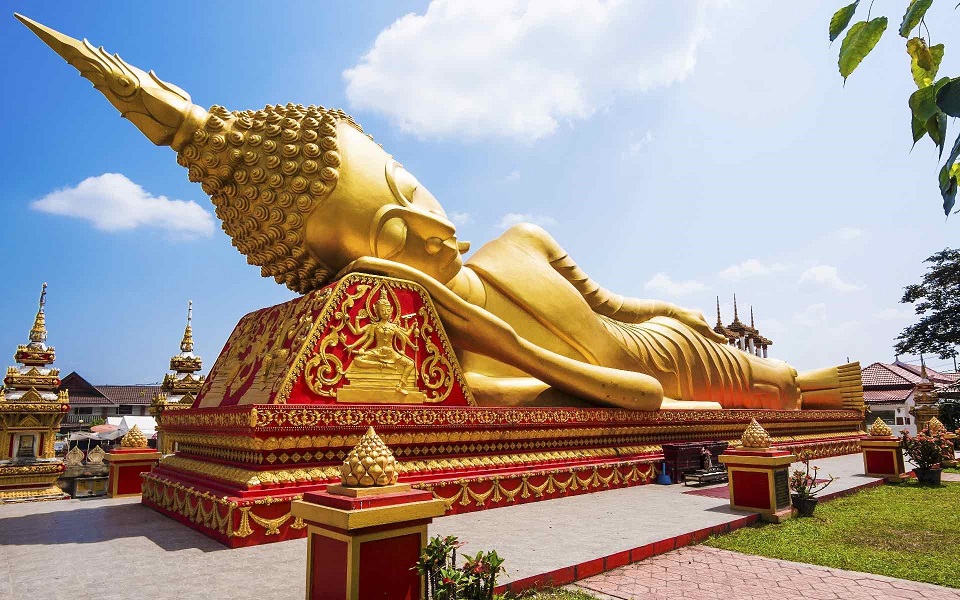
1. Visit the Golden Stupa
The most iconic experience is admiring the golden central stupa.
2. Spiritual Experience
Observe Buddhist rituals and learn about Lao religious traditions.
3. Photography
The site is extremely photogenic, especially during sunrise and sunset.
4. Cultural Learning
Discover Theravada Buddhism and Lao spiritual culture.
Nearby Attractions in Vientiane
After visiting Pha That Luang, you can explore:
- Patuxai – the Victory Monument of Laos
- Wat Si Saket – the oldest surviving temple in Vientiane
- Buddha Park – a unique sculpture park with hundreds of statues
Travel Tips
- Dress modestly and respectfully
- Bring water due to the heat
- Visit early in the morning to avoid crowds
- Respect religious spaces
- Carry small cash for the entrance or donations
Conclusion – Pha That Luang
Visiting Pha That Luang is a meaningful experience that reveals the spiritual depth, cultural heritage, and long history of Laos. As the country’s most sacred monument, it reflects centuries of devotion rooted in Theravada Buddhism, as well as the resilience and identity of the Lao people.
Whether you are interested in history, architecture, or simply looking for a peaceful place to visit, Pha That Luang offers a memorable experience that connects the past with the present.
If you would like more travel tips or detailed guidance about visiting Laos, feel free to contact us for support and recommendations.
📩Contact us here to get a free itinerary and quotation.
WhatsApp Hotline: +84965514942.
Email: info@vietnamjourneysgroup.com